There is a saying about land in Japan: “four prices for one parcel” (ichibutsu yonka). It means that one and the same piece of land carries, in addition to its actual transaction price (the market price), several values determined by public authorities. The “official land price” that a foreign owner encounters for a Niseko property is likewise not a single number. Here we explain the three official values in turn. Each is set by a different body and used in a different setting.
The official land price (kōji chika)
The first is the official land price (kōji chika). The national government (the Ministry of Land, Infrastructure, Transport and Tourism) appraises standard sites across the country as of January 1 each year and publishes the results in March. It serves as an indicator for land transactions and as the basis for pricing land acquired for public use. When the news reports that “land prices in Niseko are rising at one of the fastest rates in Japan,” it is usually this figure being discussed. It is the natural starting point for getting a sense of market levels.
The rosenka for inheritance and gift tax
The second is the rosenka (roadside land price, used for inheritance tax). The National Tax Agency sets a value for each road as of January 1 every year and publishes it in July. It is the standard for valuing land for inheritance tax and gift tax, and is set at around 80% of the official land price as a guide. In the Niseko area, rosenka in the Hirafu district has risen sharply on the back of inbound demand. In inheritance and gift situations, the valuation based on rosenka is the starting point for taxation (see graph).
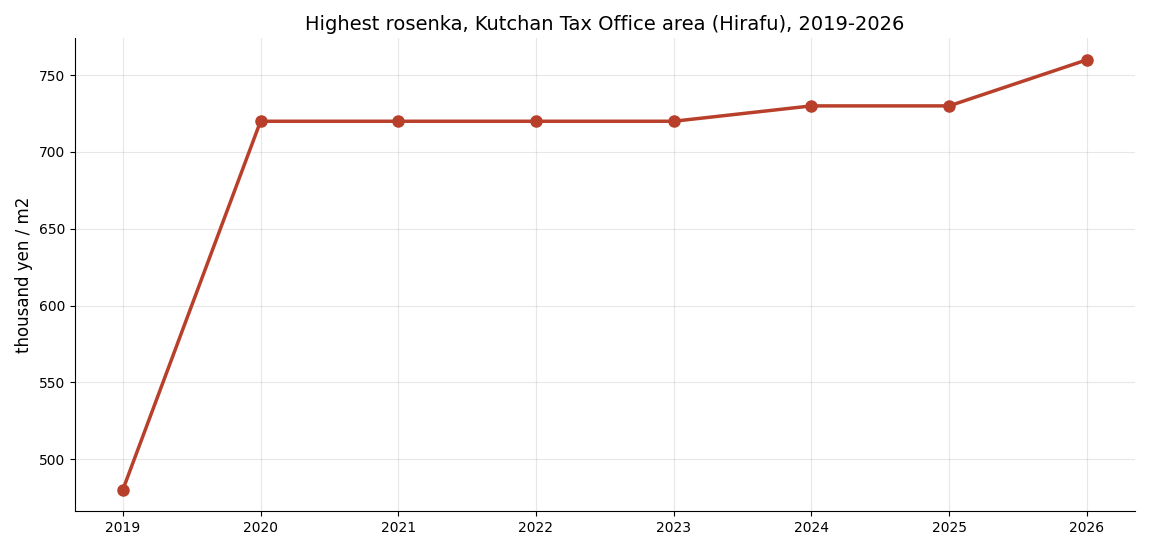
Graph: the highest rosenka in the Kutchan Tax Office district (Niseko Hirafu area, along the prefectural road Niseko Kōgen Hirafu line), based on the figures published each year by the Sapporo Regional Taxation Bureau.
A gift, incidentally, can arise without land changing hands at all — for example where a couple buying a home in Japan together registers ownership shares that do not match what each contributed.
The fixed asset tax value
The third is the assessed value for fixed asset tax. This is the value determined by the municipality where the property is located under the fixed asset valuation standard, reviewed once every three years, with roughly 70% of the official land price as a guide. It is used for the annual fixed asset tax and city planning tax, and also in calculating real estate acquisition tax and registration and license tax when you acquire property. This is the value shown on the tax notice that arrives from the municipality every spring.
Valuing land in Niseko?
We advise on the tax side of holding, gifting and inheriting Japanese property — by email.
Every enquiry is read and answered personally by the principal — first reply within 3 business days.
Get in touch